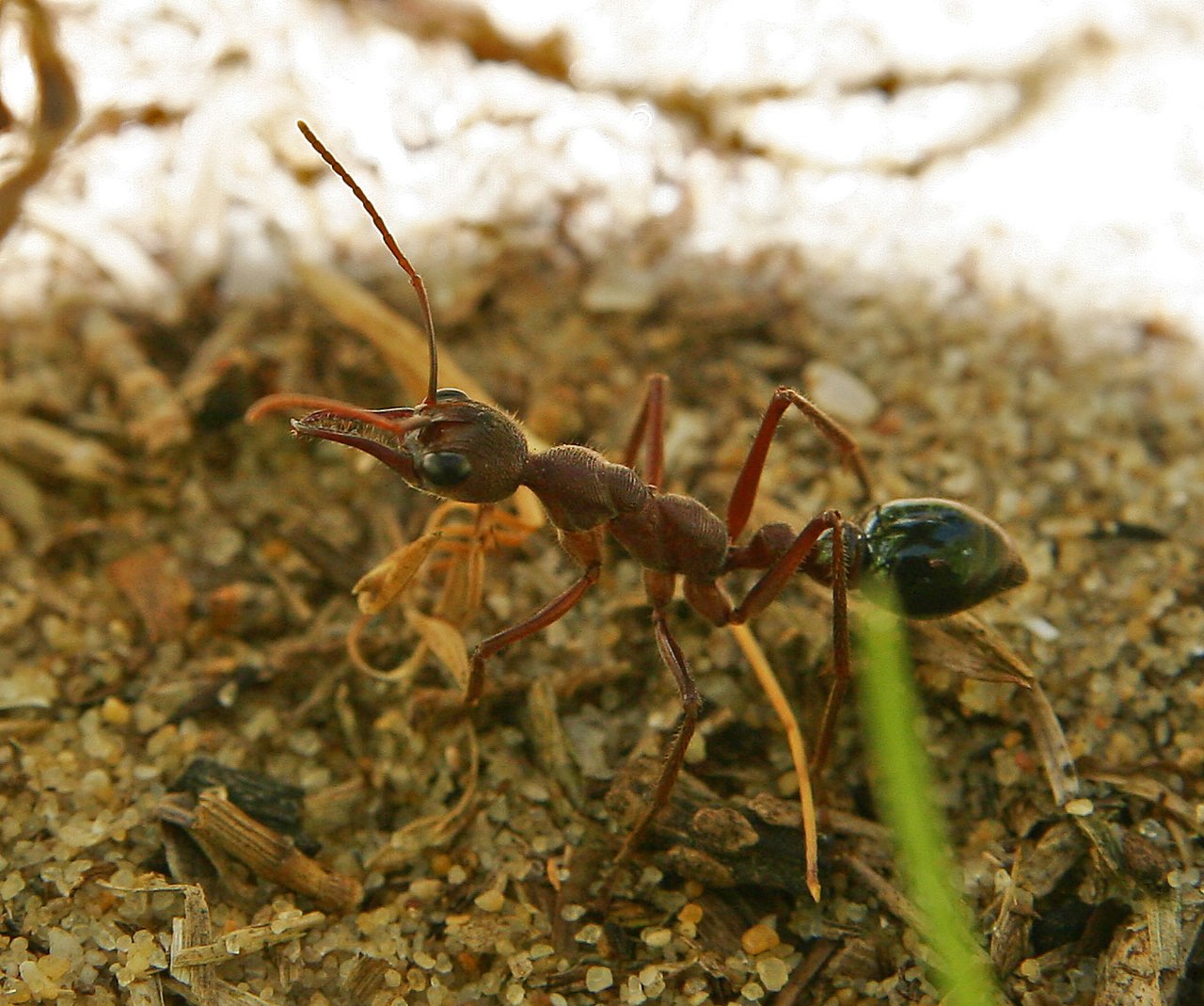
The Enigma of the Bull Ant's Return Journey: Unraveling Nature's GPS
For those who've ever pondered the remarkable question, "Wie Finden Bulldoggen Ameisen Zurück In Ihr Nest?" – or in English, how do bulldog ants find their way back to their home – the answer lies in a fascinating blend of instinct, sophisticated sensory perception, and biological computing. These formidable creatures, native to Australia, employ a multi-faceted navigation system that rivals any human-engineered GPS. Far from merely wandering, Myrmecia ants, commonly known as bulldog or bull ants, demonstrate an extraordinary ability to remember and relocate their subterranean nests, even after long foraging expeditions. Their secret? A powerful combination of chemical cues, an internal 'step counter', and a highly developed visual memory.
Bulldog ants are not your average backyard ant. They are large, aggressive, and possess a powerful sting, making them a force to be reckoned with in the Australian outback. Living in extensive underground networks that can stretch several meters deep, often beneath rocks, logs, or in loose soil, these ants are highly territorial and efficient predators. What sets many species of these ants apart from their smaller cousins is their remarkably acute vision, which plays a pivotal role in their homeward journey. Understanding how they combine these senses offers a profound insight into the complexities of insect intelligence and navigation.
A Masterclass in Chemical Communication: The Pheromone Trail
Like many ant species, bulldog ants leverage the power of chemistry to mark their paths. This isn't just a simple scent; it's a dynamic, information-rich "duftstraße nach hause" or scent road home. As a bulldog ant embarks on a foraging trip, exploring new territories for food, it continuously lays down an invisible trail of pheromones – chemical signals secreted from specialized glands onto the substrate. Think of it as leaving a breadcrumb trail, but one made of molecules.
- Trail Laying and Following: When an ant discovers a food source, it intensifies the release of pheromones on its return journey, signaling the discovery to others. This reinforcement creates a stronger, more attractive path, guiding other worker ants to the bounty.
- Information Highways: These pheromone trails are not just directional; they can convey urgency, the quality of a food source, or even danger. The strength of the scent can indicate how recently the path was used or how many ants have traveled it.
- Limitations and Resilience: While incredibly effective, pheromone trails are susceptible to environmental factors. Rain can wash them away, and human interference (like wiping a surface) can disrupt them, causing temporary confusion. However, the ants' other navigational tools quickly kick in to compensate, demonstrating the redundancy built into their system.
This chemical communication system is foundational, especially for initial exploratory phases or for recruiting large numbers of workers to a rich food source. It's a collective intelligence at work, built on molecular messages.
Their Internal Odometer: Path Integration and the 'Step Counter'
Beyond the chemical breadcrumbs, bulldog ants possess an astonishing internal navigation system often referred to as 'wegintegration' or path integration. This acts as a kind of built-in GPS or "schrittzähler" (step counter), allowing them to continuously calculate their position relative to their nest. Imagine leaving your house and keeping track of every turn, every step, and every distance covered – that's what these ants do instinctively.
- The Core Mechanism: As an ant moves, it keeps a running tally of its distance traveled and its direction. It constantly updates an internal representation of its position relative to the nest entrance. This allows it to compute the most direct route home at any point, regardless of the winding path it took to get to a foraging site.
- Experimental Proof: Pioneering experiments have provided compelling evidence for this internal odometer. Researchers have fitted ants with "stilts" (tiny extensions on their legs), causing them to take longer steps. When these stilted ants began their return journey, they overshot their nest entrance by approximately the extra distance corresponding to their lengthened stride. Conversely, ants with shortened legs fell short of their nest. These clever manipulations definitively show that ants are gauging their progress based on stride length and count.
- Beyond Steps: While often simplified to a "step counter," path integration is more complex. It likely incorporates internal senses (proprioception), an internal clock, and a celestial compass (using the sun's position or patterns of polarized light in the sky) to maintain an accurate directional bearing. This makes it incredibly robust, even in featureless environments or when pheromone trails are absent. For a deeper dive into these fascinating mechanisms, you might find Bulldog Ant Navigation: Scent, Steps, and Sight particularly insightful.
This internal compass and odometer provide a crucial backup, allowing an ant to orient itself and head directly home even if its chemical trail has been disrupted or if it's ventured into new, unmarked territory.
Seeing Their Way Home: Visual Navigation and Landmark Recognition
Here's where bulldog ants truly distinguish themselves from many other ant species. Unlike ants that rely almost exclusively on scent in dim light, Myrmecia ants are "visuelle Profis" – visual professionals. They possess large, exceptionally well-developed compound eyes, granting them superior spatial awareness and the ability to interpret their surroundings with remarkable clarity.
- Building a Visual Map: Bulldog ants don't just see; they remember. They actively learn and store information about prominent features in their environment – trees, rocks, roots, distinctive ground patterns, or even the contours of the terrain. These serve as vital landmarks, forming a mental "visual map" that guides them home.
- Scanning and Orienting: Studies and nature documentaries often depict bull ants pausing frequently during their return journey. During these stops, they elevate their heads and "scan" the surroundings, seemingly comparing the current panoramic view to the stored visual memories of their home territory. By matching the observed patterns of landmarks with their internal map, they can correct their course and maintain the most efficient path back to the nest.
- Celestial Cues: Their visual prowess also extends to utilizing celestial cues. They can perceive the sun's position, even when obscured, and detect patterns of polarized light in the sky. This serves as another powerful compass, helping them maintain a consistent bearing over long distances, independent of ground-level landmarks.
This reliance on visual navigation is particularly effective in open, well-lit environments where distinct landmarks are available. It adds another layer of precision and resilience to their overall navigational toolkit.
The Symphony of Senses: Combining Strategies for Flawless Returns
It's important to understand that bulldog ants don't rely on just one navigational method; they expertly integrate all three. Their return journey is a sophisticated symphony where each sense plays a vital role, often complementing and backing up the others. This multi-modal approach is the true secret behind their internal GPS.
- Redundancy and Robustness: Imagine a scenario where a strong gust of wind or heavy rain washes away a pheromone trail. A less sophisticated ant might be lost. But for a bulldog ant, its internal path integration system and its visual map immediately take over, allowing it to continue its journey with minimal disruption. Conversely, if path integration drift occurs (small errors accumulating over a long journey), visual landmarks or strong pheromone trails can help correct the course.
- Learning and Adaptation: The ants continuously learn and update their navigational information. New landmarks are noted, and the efficacy of pheromone trails is assessed. This dynamic learning process allows them to adapt to changes in their environment, ensuring their navigation remains highly accurate over time.
- Ecological Significance: This sophisticated navigation system is critical for their survival. It enables them to efficiently forage over vast areas, locate widely dispersed food sources, and reliably transport food back to the colony. Their ability to do this contributes significantly to their role as effective predators and scavengers in their ecosystem. To delve deeper into the intricate strategies employed by these ants, consider reading Decoding Bulldog Ants' Nest Finding Strategies.
Conclusion: A Testament to Nature's Ingenuity
The question of "Wie Finden Bulldoggen Ameisen Zurück In Ihr Nest?" reveals a marvel of natural engineering. Bulldog ants are not just strong and aggressive; they are master navigators. By skillfully combining a chemical scent trail, an internal odometer for path integration, and a highly developed visual memory for landmarks and celestial cues, these insects demonstrate an unparalleled ability to find their way home. Their multi-faceted approach ensures remarkable accuracy and resilience, making them a fascinating subject of study for scientists and an enduring testament to the sophisticated "internal GPS" systems found in the natural world. It's a compelling reminder that sometimes, the most complex solutions can be found in the smallest of creatures.